Anniversary of the agreement that led to the creation of CENOMI: NOMES, NOMS, NOMBRES, IZENAK
Anniversary of the agreement that led to the creation of CENOMI: NOMES, NOMS, NOMBRES, IZENAK
In April 2025, the Secretary of State for Democratic Memory and the University of Santiago de Compostela, through the HISTAGRA Research Group, signed a research agreement to compile the State Census of Victims, in compliance with the mandate of the current Law on Democratic Memory.
CENOMI: NOMES, NOMS, NOMBRES, IZENAK will include all those who were killed as a result of the violence perpetrated from the 1936 coup d’état until the end of 1939 in this first phase. The core team carrying out this work is based at CISPAC, the Inter-University Research Centre for Atlantic Cultural Landscapes, comprising the three Galician universities (USC, UdC and UVigo). It is led by Lourenzo Fernández Prieto, Professor of Contemporary History at the USC, and Antonio Miguez Macho, PhD in Contemporary History at the USC, with coordination headed by Cochi López Sánchez, PhD in Contemporary History.
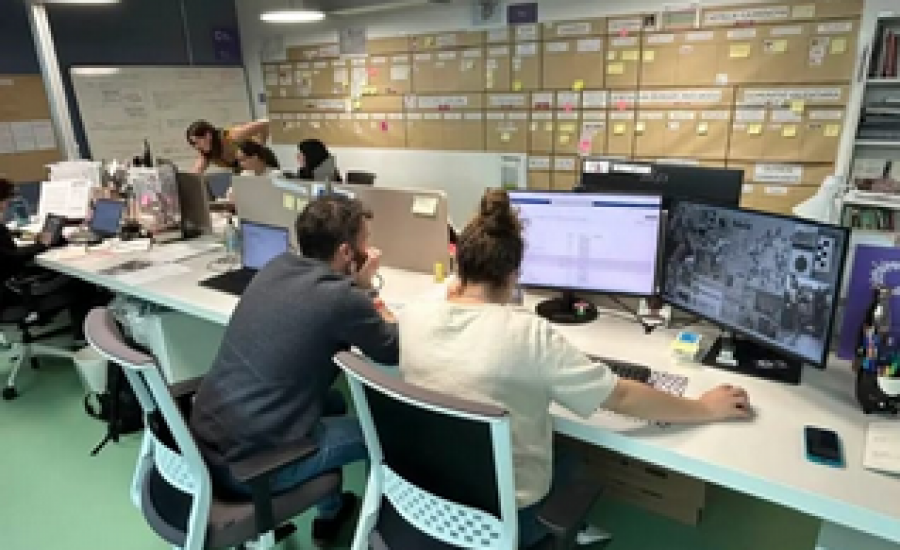
The project is based on historical research methodology: source criticism and analysis, qualitative and quantitative assessment of information, and heuristics. Technically, it uses the ‘Dédalo’ platform, a computerised system for the management and dissemination of cultural heritage information with a proven track record spanning more than twenty years. The CENOMI team works directly on this platform to record information derived from the search for fatalities during the period from July 1936 to December 1939. As a result of the investigation, by establishing the traceability of the sources, ensuring their cross-verification and the method for validating names, we generate a nominal list of victims which also includes—where possible—a range of biographical details on the identified individuals: age; profession; place of birth, hometown, place of death...; or the type of violent incident of which they were victims.
The objectives of the research are:
To compile a map of organisations and working groups with prior experience in this field.
To design a preliminary plan defining the steps and methodologies required to extend, in a second phase, the time frame of the census to 1942.
To contribute to the creation, dissemination and critical examination of scientific, technical and humanistic knowledge, with a view to promoting education based on democratic principles and the defence of peace and human rights.
To engage in historical research, the study of the recent past and the promotion of democratic remembrance.
A project of this scale requires the establishment of teamwork approaches that are dynamic, structured and flexible, in order to capitalise on the wealth of knowledge and experience available within the fields of historiography, technical expertise and civil society.
To this end, various working and consultation groups and councils have been set up:
Liaison Group: Histagra-CISPAC-USC and the Ministry of Territorial Policy and Democratic Memory (MPTMD).
Internal Academic Advisory Council (CAAI)
External Academic Advisory Council (CAAE).
Technical Advisory Council (CAT).
Liaison Group: Histagra-CISPAC-USC and the Ministry of Territorial Policy and Democratic Memory (MPTMD). This group is responsible for the overall monitoring and coordination of the project, as set out in the founding agreement. Management Team: Jaime del Rey (MPTMD) and Lourenzo Fernández (USC). Co-ordinating team leaders: José Luis Muñoz (MPTMD) and Antonio Míguez (USC). Co-ordinating team: Antonio Gómez (MPTMD), Iván de Castro (MPTMD), Ana Cabana (USC), Daniel Lanero (USC) and Eduardo Rico (USC). Working team: Conchi López Sánchez (technical research coordinator), Laura Martínez Panizo (pre-doctoral researcher), Gael Uxío Proupín Cantelar (pre-doctoral researcher), Mirian Adrio Nieto (pre-doctoral researcher) and Alberto González Remuiñán (postdoctoral researcher).
Internal Academic Advisory Board (CAAI), comprising historians with extensive experience in empirical research in this field and in participating in multidisciplinary teams. Most were involved in the inter-university project ‘Nomes e Voces’ and are familiar with the management and interpretation of data from victim censuses: Ana Cabana Iglesia (USC); Andrés Dominguez Almansa (USC); Daniel Lanero Táboas (USC); Dionisio Pereira (freelance); Eduardo Rico Boquete (USC); Emilio Grandio Seoane (USC); José Ramón Rodríguez Lago (UVigo); Julio Prada Rodríguez (UVigo); Ramón Villares Paz (USC)
External Academic Advisory Board (CAAE), comprising researchers of recognised historiographical standing. Its role is to provide methodological and critical conceptual support for the project’s operational decisions: Miguel Ángel Del Arco Blanco (UGR); Juan Luis Pan-Montojo González (UAM); Santiago Manuel López García (USAL); José Miguel Gastón Aguas (Navarre Institute of Memory); Manuel Ortiz Heras (UCLM); Jaume Claret Miranda (UOC); Alejandro Pérez-Olivares (ULL); Jordi Guixé y Coromines (UB); Gemma Domenech Casadevall (ICRPC-UdG); Javier Rodrigo Sánchez (UAB); Antonio Rivera Blanco (UPV-EHU); Jon Mirena Landa (UPV-EHU); Ángela Cenarro Lagunas (Unizar); José Luis Ledesma Vera (UCM); Laura Muñoz Encinar (INCIPIT-CSIC); Francisco Villaamil Fernández (UC3M); Zoe De Kerangat (UNED); Candela Chaves Rodríguez (UNEX); Ángel Luis López Villaverde (UCLM); José Javier Rodríguez González (Unileon); Enrique Berzal De La Rosa (UVA); Francisco Sevillano Calero (UA); Béchir Yadizi (ISHMN-Tunisia); Magdalini Fytili (UCM); Ricard Conesa Sánchez (UNED); Queralt Solé Barjau (UB); Verónica Sierra Blas (UAH); Carmen García García (Uniovi); Francisco Acosta Ramírez (UCO); Josep Calvet Bellera (Memorial Democràtic); Fernando del Rey Reguillo (UCM); Gustau Nerín (UB); Óscar Rodríguez Barreira (UAL)
The Technical Advisory Board (CAT) brings together individuals and professionals who have spent years working on the management of victim data on similar platforms. Its members have specialist expertise in technical and structural aspects of the design of IT tools for information management: Álex Peña (Render); César Layana (Navarre Institute of Memory); Eulàlia Mesalles (Government of Catalonia); Gerard Corbella (La Fonería); Josep Calvet (Memorial Democràtic); M.ª José Serrano (Obrador d'Idees); Mercè Pujadas (Memorial Democràtic); Roberto Palacios (Gogora); Ruth Cancelo (Gogora)